Sunday, 16 September 2012

Precedent Study *Updated*


Selected Buildings:

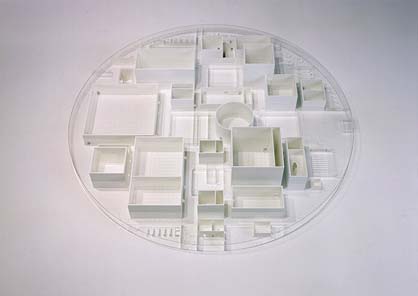
21st Century Museum of Contemporary Art, Kanazawa - SANAA
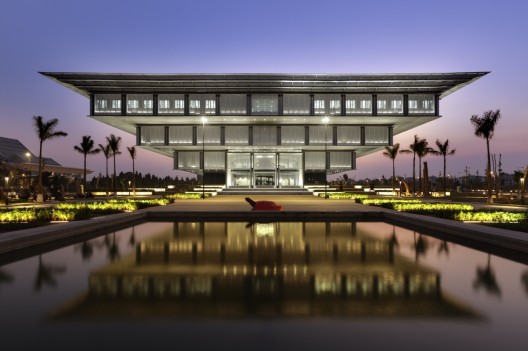
Hanoi Museum - gmp Archtekten


21st Century Museum of Contemporary Art, Kanazawa
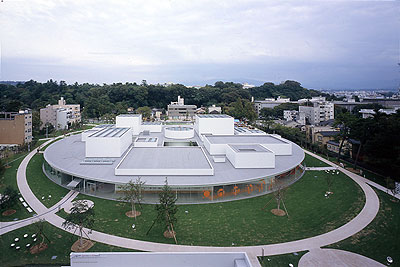


Hanoi Museum


Comparative Study
Both of these buildings are made predominantly of basic shapes: quadrilaterals and circles. They both use
the repetition of these simple shapes in order to achieve an interesting piece of architecture.
The main shape of the Hanoi Museum is a square, whilst the main shape of the 21st Century Museum is a circle.


Both buildings appear to sit on a "glass" base, giving the buildings a sense of lightness.

The forms of the two buildings are opposites to each other.
In the Hanoi Museum, the building is "top heavy", where the base is smaller than the top of the building.
The 21st Century Museum follows a more traditional form, where the base is larger than anything above it.


Proposed Buildings
- Hotel/Lodge: I feel that I could create a sense of a different experience of the same place through the use of different distortions in the repetition of shapes used to create each room.

- Theatre: I feel that a theatre can reflect upon my concepts well, where the repetition of the simple shapes can ultimately create something that is definitely out of the ordinary.

An idea I wanted to play with in my building was the distortion of the "base". In the 21st Century Museum, the "base" is the largest piece at the bottom of the building, where the rest of the building extrudes out from.
In the Hanoi Museum, the "base" is actually a smaller piece of the building, where the largest piece is actually at the top of the building, giving a sense that the building has extruded downwards rather than upwards like a traditional building. 
In my proposal, one idea I had was to have the "base" sit on its side, standing up, where the building would extrude from the sides of the "base", distorting and manipulating the idea of a "base" of a building.


Thursday, 13 September 2012

Project 2: Precedent Study


Selected Buildings:

21st Century Museum of Contemporary Art, Kanazawa -SANAA

Jiaxing College Library & Media Center - LYCS Architecture


21st Century Museum of Contemporary Art, Kanazawa


Jiaxing College Library & Media Center


Thursday, 23 August 2012

Assignment 2 Submission

Distorted Regularity

My two concepts explored in this assignment were:
1. The repetition of simple shapes.
2. The distortion of the ordinary to create the extraordinary.

The repetition of simple shapes is conveyed through my model from the physical shapes that make it up. The model is made entirely out of squares and cubes. The repetition of the square shape creates a simple yet interesting model to look at due to the composition of the various squares. This also translates to my physical model, where it is in the physical form of a cube, one of the predominant shapes of the model, and one of the most simple three dimensional shapes.

The distortion of the ordinary is explored through the modifiers I placed on my model to make it a more complex shape. Whilst it is explored through the shape and form of the model, it is also heavily conveyed through the materials of the model. The reflective twisted surfaces do not give a straight reflection, but rather a distorted reflection. The rings around the model are given a translucent glass texture, distorting the objects behind it when we look through it. This concept of distortion is central to the idea of my physical model. Taking the simple shape of a cube, we distort (twist) the cube in order to progress through the unpacking and development of my model, very similar to the model itself.


Storyboards and Draft Models

Throughout the assignment, various storyboards were drawn up for the animations.

This was an early storyboard made in a class.


This is the finalized storyboard used for the animations. The marker combinations were also planned in this storyboard.

Slight changes were made to the model from the first assignment.
Further alterations to the color of the model were made in later stages of the assignment.

BuildAR

These were initial tests with BuildAR using my models from the first assignment.


These are some of the final models used in BuildAR.


Markers

In order to achieve my physical model, I had to split my markers into halves. All 9 markers used in the model are a different combination of 2 of the 6 different halves created.
Many of the halves represents different forms of distortion that when used together can be used to create the extraordinary from simple shapes.

This Marker halve represents the splitting of a simple shape.

This Marker halve represents the skewing of a simple shape.


These two Marker halves represents non-parallel skewing of simple shapes.

This Marker halve represents the projection of a simple shape that is then skewed.

This Marker halve represents the interesting patterns that can be created when overlapping simple shapes upon each other.

3DS Max Renders

The environment where the model sits in is littered with cubes. This represents my concept of the repetition of the simple shape. When trying to show the concept of distortion, all these cubes are turned yellow and twisted.


These two above renders were rendered from the same point of view, allowing me to combine the two renders to create an amalgamation of the two concepts.

The idea behind this render was a distortion of the model and its environment. To achieve this, I rendered the reflection of the environment from a spherical mirror. I played around with different sizes and distances until I ended up with this result. 
Originally, I was planning to render the object and the environment through sheet of glass which bent, distorting the view through refraction.

A3 Poster


Required files submitted to course folders.